
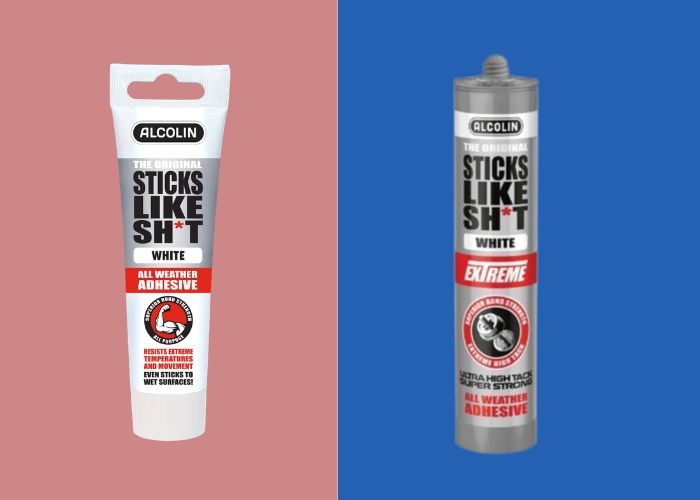
Which of These Alcolin Adhesives Is Most Suitable for You?
Listen, we’ve all been there. You’re trying to fix a heavy mirror or a set of skirting boards, and the moment you let go, they start a slow, painful slide down the wall. It’s the kind of frustration that turns a Saturday DIY project into a proper headache. Whether you’re working on a damp site or trying to bond different bits and pieces in unpredictable weather, you need a bond that’s going to hold the first time.
The Alcolin “Sticks Like Sh*t” range is legendary for a reason, but there’s often a bit of confusion between the “Standard” version and the newer Extreme version.
While both are high-performance, picking the wrong one could mean your fixture ends up in a heap on the floor or, worse, ruins an expensive piece of stone.
Let’s get stuck into the technical aspects so you can get the job done right.
Sticks Like Sh*t Extreme Offers Instant Initial Tack
The biggest difference you’ll notice on-site is how these two behave the moment you press them against the wall.
The standard Sticks Like Sh*t adhesive is brilliant, but it needs a bit of help while it’s curing. You’ll need to use 3 mm-thick double-sided tape or some mechanical fixings to support the weight for the first 24 hours. If you don’t, that mirror is going for a walk.
Sticks Like Sh*t Extreme, however, is a different beast entirely. It features extremely high initial tack, which is pro-talk for “this thing grabs and won’t let go.” It’s designed to hold heavy objects immediately without any bracing or temporary support. For a contractor, this is a massive time-saver. No more messing about with temporary supports or coming back the next day just to remove tape.
Professional Grade vs. DIY Reliability
While both come from the same trusted staple brand, they are engineered for different levels of intensity:
Standard Sticks Like Sh*t
This is your go-to for general DIY around the house. It’s a versatile “pro-in-a-tube” for fixing common things like wood and PVC. It’s not recommended for professional construction applications. It’s reliable for home repairs, but keep it for the DIY stuff.
Sticks Like Sh*t Extreme
This is a high-quality professional adhesive. It’s engineered for heavy-duty fixtures and demanding construction projects where you absolutely can’t afford a failure. It’s what you want in the back of your bakkie for the tough jobs.
The Extreme Version Is Suitable for Natural Stone
If you’ve spent a fortune on marble, granite, or other porous natural stones, pay attention. The standard version is not suitable for natural stone. Since stone is porous, the adhesive components can migrate into the material, leaving permanent, ugly shadows or stains on your finish.
Sticks Like Sh*t Extreme was developed specifically to be non-staining. It’s the only choice for porous building materials. It ensures your expensive stone features stay looking pristine without any adhesive “bleeding” through to the surface.
Technical Performance Comparison by the Numbers
When a building shifts or vibrates, you need an adhesive that can flex without snapping. In the world of adhesives, we use elongation at break to measure far an adhesive can stretch. Extreme offers 400% elongation, double the standard version, meaning it’s much better at absorbing structural shifts.
Also, look at the 100% Modulus (a material’s stiffness and resistance to deformation). Extreme’s lower value (1.20 vs 1.75) means it’s a “softer,” more flexible rubber once cured, which puts significantly less stress on the bond line when things move.
| Feature | Alcolin Sticks Like Sh*t Standard White | Alcolin Sticks Like Sh*t Extreme White |
| Base | Moisture-curing SMP* | Hybrid |
| Tensile Strength (N/mm²) | 2.05 | 2.20 |
| Elongation at break (%) | 200% | 400% |
| 100% Modulus (N/mm²) | 1.75 N/mm² | 1.20 N/mm² |
| Application Rate (g/min) | 500 – 800 g/min | 10 – 20 g/min |
*Note: While the White standard version is SMP-based, the “Clear” version uses a Hybrid base.
A Note on Application Rate: You’ll notice the Extreme version has a tiny application rate (10-20 g/min) compared to the Standard version. This means the Extreme paste is incredibly thick and stiff. Don’t try to use a cheap, plastic R20 caulking gun with this. You’ll break the gun.
You need a high-quality, heavy-duty professional caulking gun to extrude the Extreme version properly.
Shared Limitations of Standard and Extreme Alcolin Sticks Like Sh*t
Even the toughest adhesives have their limits. Neither of these will work on:
- Some plastics: Polyethylene (PE), Polypropylene (PP), and Teflon.
- Rubbers: Neoprene and plasticised PVC.
- Conditions: Bituminous surfaces, weak/crumbly material, or completely underwater.
PRO TIP: Never use these products in swimming pools or areas with continuous exposure to chlorides. Also, if you’re bonding a mirror, check the back. If it has a plastic safety film, neither of these will stick to it. You need a direct bond to the mirror backing.
Application Secrets for a Permanent Bond
To get a proper job that lasts, you have to follow the rules of moisture-curing adhesives:
- Prep is King: Everything must be clean, dust-free, and free of oil or rust. If the surface is damp, check that it isn’t hiding loose or crumbly bits.
- The “Ventilating” Method: Always apply in vertical stripes 10-20 cm apart. Never run your stripes horizontally. This traps moisture and stops the adhesive in the middle from curing.
- No Dots or Dabs: Applying in blobs traps air and creates weak spots. It’s a one-way ticket to a bond failure.
- Extreme Rule: For the Extreme version, apply the adhesive to one surface only.
- Maintain the Gap: When you press the materials together, don’t squash it flat. You need a minimum adhesive thickness of 2-3 mm to allow the bond to “breathe” and flex.
Sticks Like Sh*t vs. Sticks Like Sh*t Extreme
So, which one goes into the trolley?
- Choose Standard if: You’re doing general DIY repairs, you need a transparent finish (only Standard comes in “Clear”), or you’re bonding common materials like wood and ceramics.
- Choose Extreme if: You’re a pro doing a proper installation, you’re bonding heavy objects where you can’t use supports, or you’re working with natural stone.
Get the right tube for the job, follow the prep, and your project will stay exactly where you put it. Happy building!